Saturday, 27 May 2017

Justice Ofili-Ajumogobia Owes Me N18m, Refuses To Pay Back – Witness

Justice Ofili-Ajumogobia Owes Me N18m, Refuses To Pay Back – Witness


A prosecution witness in the ongoing trial of suspended judge of the Federal High Court, Justice Rita Ofili Ajumogobia Friday told a Lagos State High Court in Ikeja that the judge stopped picking his calls after she borrowed N18 million from him to buy a property in the UK.
The witness, Dr Gregory Ero, who is the founder, Chief Executive Officer of Arkleel Oil and Gas told the court that the embattled judge despite promising to repay the money refused to do so and after sometime stopped picking his calls.
The Economic and Financial Crimes Commission (EFCC) had arraigned Justice Ofili-Ajumogobia and a Senior Advocate of Nigeria, Godwin Obla before the court on a 30-count charge of conspiracy to pervert justice by allegedly giving and receiving a bribe of N5 million.
The anti-graft agency had also alleged that about $793,800 passed through the Justice Ajumogobia’s domiciliary accounts with Access Bank between 2012 and 2015 and that she allegedly used the money to buy a house in London.
Five of the charges are centered on an alleged N5m bribe given to the judge by the senior advocate while the remaining 26 charges are on the huge amounts that passed through the accounts of Ofili-Ajumogobia and her alleged inability to explain her source of wealth.
The other charges filed against the judge border on forgery, lying, unlawful enrichment and other related offenses.
They both pleaded not guilty to the charge.
Ero who was the ninth prosecution witness in the case claimed, “I knew Ajumogobia sometimes in 2002 before she became a Federal High Court Judge. She was employed when we outsourced for a secretary.
“She was paid ad hoc fees as we did not have a regular structure as at then. She worked with us for two years before she was appointed as a Judge.
“She came to our office one day after she stopped working with us and sought to have a private audience with me. I obliged and she asked for a loan of N18 million because she had pressing needs.
“I enquired what the urgency was about and Ajumogobia told me that she had a shortfall of N18m for a property she wanted to buy in the UK as she needed to move out of the family house immediately.
“As a Christian I obliged her request and also based on the fact that she is known to me. She went further to tell me that she has properties which would generate rent while also giving me a payment plan for the repayment of the loan.
“Sadly after a year she did not pay back. I started calling her and she would pick my call. But between 2012 and 2013 she stopped picking my calls.
“I personally went to her house but I was turned back at the gate when I was informed that she was not around. I went to her house more than twenty times but I was always turned back at the gate.
“I am disappointed in Ajumogobia as I find her actions bizarre. Up till now, she has refused to pay me my money. I still need my money as the money was taken from our retail earnings. I have not written it off, I still need my money,” he said.
Also during Friday’s proceedings, a Deputy Comptroller General of Customs, Tahir Audu Musa also told the court that the Comptroller General of Customs Abdullai Dikko Inde gave him a slip of paper which contained the name, Nigel and Colive, a company owned by Ajumogobia.
“The DG sometimes in 2014 called me back and gave me the name of the company directing me to tell one Musa Omale to liase with some area comptrollers and transfer 1 million each to Omale’s account for onward transfer to the company’s account.
” The Customs Commands mentioned are: Apapa, Tincan Island, Kirikiri Landing Terminal, Murtala Mohammed, Federal and Sea, Onne Air and Ogun State Command, Tahir said.
The witness however said that he did not know why the money was paid into Nigel and Colive’s account.
The trial judge, Justice Hakeem Oshodi has adjourned the matter rill June 1 for further hearing.

U.S. Ambassador Unveils First State-Of-The Art American Space In Nigeria

U.S. Ambassador Unveils First State-Of-The Art American Space In Nigeria

U.S. Ambassador Unveils First State-Of-The Art American Space In Nigeria
The United States Ambassador to Nigeria Mr. W. Stuart Symington yesterday unveiled Nigeria’s first state-of-the art Priority American Space hosted at the Yaba offices of technology incubator, Co-Creation Hub (CC-Hub).
At the event attended by technology leaders, Ambassador Symington explained that the space, which is equipped with cutting-edge digital technology, is a center for Nigerians to develop innovative ideas, learn about the United States and its people, explore possible study at U.S. universities, enjoy U.S. cultural programs and also interact with U.S. exchange program alumni.
“At the Priority American Space in Lagos, we are investing in technology and programs to unleash the creativity of Nigeria’s burgeoning community of innovators. We are pleased to partner with Co-Creation Hub, a leading force for incubating social entrepreneurship and technological advancement,” Symington said.
The Centre, now open to the members of the public, comprises a Maker Space –– a tech area designed to promote digital skill building; a workshop space equipped with the latest laptops and tablets for internet learning; a conversation space for small group meetings and research and a meeting space that supports innovation and creative collaboration.
With a rich array of programs and trainings, the Priority American Space which is the tenth of its sort in Africa, will promote ingenious ideas, critical thinking and reasoned discourse.
It was learnt that there are 67 Priority American Spaces Worldwide.

Burundi Forces Unwed Couples To Marry

Burundi Forces Unwed Couples To Marry


Unmarried couples have until the end of the year to legalise their relationships, the Burundi government said Friday, as part of an effort to reform morals in the country.

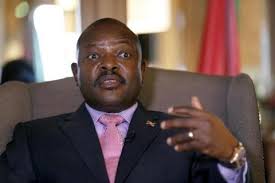
The order follows the launch of a campaign this month by President Pierre Nkurunziza “to moralise society” in the tiny nation which for two years has been in the grip of sometimes violent political upheaval.

Interior ministry spokesman Terence Ntahiraja told AFP the country was facing a population explosion which he blamed on “illegal marriages”, polygamy, bigamy and “hundreds of schoolgirls getting pregnant”


He said church and state-sanctioned weddings were the solution and were a patriotic duty.


Nkurunziza said Burundians should show their love for each other — and their country — by getting married.
The government has since been pressuring unwed couples across the country to tie the knot.
The governor of the southeastern province of Rutana has ordered that “persons living in common-law unions” should be put on a special list by 22 June, while the governor of the northwestern Bubanza province has demanded unspecified “sanctions” against aisle-dodgers.
Pierre, a 27-year-old farmer living with his partner in Ngozi, in the north, said local officials had threatened him with a 50,000 Burundian franc ($25/22 euro) fine and said any child born out of wedlock would not be eligible for free education and medical costs.
Pierre said he had not married because he could not afford the bride price demanded by his girlfriend’s family.
“She told me she was pregnant. As I am poor, we decided to come together to raise our child,” he said. “We thought we would legalise our union as soon as we could afford it.”
That was five years ago and the couple is now onto their third child.
To enact the president’s orders, officials have begun organising mass weddings, something one civil society activist opposed as “a violation of human rights because the state has no right to attack two adults who have decided to live together without being married.”
The activist said the forced marriages were part of a “religious crusade” led by Nkurunziza and his wife, both fervent, born-again evangelical Christians.
Spokesman Ntahiraja dismissed such arguments saying the government’s campaign was within the law.
“We want Burundians to understand that everyone is responsible for his life, we want order in this country,” he said.
“All this is done within the framework of the patriotic training programme,” he added, referring to an initiative launched by Nkurunziza in August 2013 to reinforce “positive traditional values.”
Since 2015, when Nkurunziza ran for a controversial third term, at least 500 people have been killed in political violence while around 400,000 have fled Burundi for refugee camps in neighbouring countries.

Monday, 27 March 2017

Obasanjo’s Wife Asks Court To Postpone Son’s Wedding

Obasanjo’s Wife Asks Court To Postpone Son’s Wedding


Mrs Taiwo Obasanjo, one of the wives of former President, Olusegun Obasanjo has dragged her husband and lottery business mogul, Sir Kessington Adebutu before the Lagos State High Court in Ikeja seeking an order of the court to stop the wedding of her son, Olujonwo Obasanjo.

Mrs Obasanjo is asking the court to mandate the former president and the father of the bride,
Sir Adebutu, popularly known as  ‘Baba Ijebu', to postpone the wedding of her son to Tope Adebutu which is alread fixed for May 11 and 12.

Mrs Obasanjo who is the twin sister of Chief Kenny Martins, the former coordinator of the Police Equipment Fund, wants the wedding date to be postponed to sometimes after June 1.

She is also praying the court for declaration that as the mother of the groom, she has parental rights to take part in the deliberations, decisions and activities leading to the forthcoming ceremony.

According to affidavit attached to the suit, she averred that wedding invitations have been issued and she has been excluded from the preparations for the upcoming nuptials.

She stated in court documents that prior to the fixing of wedding dates, she had a premonition regarding her son who turns 34 on June 1.
According to her, she also received prophesies and spiritual warnings to the effect that Olujonwo should not undergo any elaborate celebration before his birthday which is two weeks after the wedding to avoid any impending calamity.

Mrs Obasanjo stated in court documents that she commenced the suit to compel Adebutu and Obasanjo to shift the wedding to a date beyond June 1.

She also claims that she appealed to Adebutu, the father of the bride, Mrs Rosemary Dacosta, the mother of the bride, Tope Adebutu, the bride-to-be as well as her twin brother Chief Kenny Martins.

Mrs Obasanjo said her pleas fell on deaf ears and she was instead, insulted by members of the family.

The suit with number ID/262FPM/2017 which is before Justice Lateefa Okunnu has neen fixed for April 10 for hearing.

Friday, 24 March 2017

Appointment Of SANs To Supreme Court Will Kill Moral Of Brilliant Judges -Babalakin

Appointment Of SANs To Supreme Court Will Kill Moral Of Brilliant Judges -Babalakin

A Senior Advocate of Nigeria (SAN), Dr Wale Babalakin on Thursday warned against the proposed appointment of SANs and other lawyers to the Supreme Court, stating that it would kill the moral of brilliant judges at the lower bench.

Babalakin insisted that lawyers who are appointed straight to the Supreme Court come once in a life time, and are of exceptional intellect.

The senior lawyer, who was speaking at 10th memorial lecture in honour of Kehinde Sofola (SAN), also said such appointments are not meant for “pedestrian advocates”, adding that it would kill the moral of brilliant judges at the lower bench.

It will be recalled that the Chief Justice of Nigeria (CJN) Justice Walter Onnoghen had invited the Bar to nominate lawyers for appointment as Supreme Court justices, following which the Nigerian Bar Association (NBA) shortlisted nine persons, including six SANs.

But Babalakin maintained that the legal system should rather be structured in a manner that only very gifted lawyers aspire to judicial appointment, adding that it is the only way to provide justice according to law.

He said: “The fact that you are a good lawyer doesn’t necessarily mean you will be so exceptional as to be a Supreme Court Judge.

"The protagonists of this proposal mentioned some names that have made it to the Supreme Court directly from the Bar. Dr Taslim Elias’s curriculum vitae speaks for itself.

“Another judge that was appointed directly to the Supreme Court in another jurisdiction is Mr. Justice Jonathan Sumption. Jonathan Sumption took a first class degree in Medieval History from Oxford University.

“These are the caliber of men who can make a claim to a direct appointment to the Supreme Court of any country. They come once in a life time.

“This hop, step and jump is not meant for every pedestrian advocate who has nothing to show than a prolonged stay in the courts with relative lack of distinction.

“If you are considered so gifted, an exception can be made for a few appointments to the Courts of Appeal where, if you now distinguish yourself, you can be given an accelerated promotion to the Supreme Court.”

Babalakin spoke on the theme: The role of the legal profession in nation building: the Nigerian context.

Recalling the judiciary’s ‘glorious years’, Babalakin, called to the Bar 35 years ago, said the law profession he knew growing up was very organised, cases proceeded on the dates they were scheduled for, there were hardly any adjournments, objections were raised and resolved immediately, and there was no adjournment to consider any interlocutory issue.

He said judges were so knowledgeable and so versatile that lawyers knew they could not play any delay tactics, while criminal cases were disposed of within a month of commencing trial.

Babalakin said judges were also well paid. According to him, in 1964, the salary of a High Court Judge in Western Nigeria was £3,400 per annum, higher than that of the Central Bank of Nigeria (CBN) governor, which was £2,700 per annum.

The SAN said the military intervention in governance was “an unmitigated disaster in the development of the Nigerian legal system and the Legal profession," adding that it culminated in the retirement of exceptional judges in 1975 without due process, a development he described as “the greatest set back to the legal profession”.

On the way forward, Babalakin said the study of law must be made a serious business, with the improvement of the quality of teaching, which, to him, “is simply not good enough.”

He said appointment to the Bench must be based on merit rather than federal character, as law is essentially a profession that requires very serious intellectual capacity.

For instance, Babalakin said the current members of the Supreme Court of England are either graduates of Oxford University or Cambridge, while those of the United States Supreme Court are all graduates of America’s best universities.

“These countries realise that you cannot place the judicial process in the hands of less qualified people. As I have often repeated, there is no difference between an incompetent judge and a corrupt judge. The effect of incompetence and corruption on the legal system is the same; that is injustice,” he said.

On delays, Babalakin said frivolous adjournments must be discouraged, while courts must not adjourn any case for the convenience of counsel.

The courts, he said, must be ready to proceed with matters.

Prosecution of criminal cases, he added, should only take place after a very thorough investigation and review of the evidence by very seasoned legal practitioners, as, according to him, poor prosecution of cases have considerable negative effect on the legal system.

“The idea that the prosecution would seek to adjourn the trial of a criminal cases because it requires more time to adduce or compile evidence must be very strange to those who are familiar with the operation of the common law in prosecution of criminal cases,” he said.

On corruption in the judiciary, Babalakin said the discipline of judicial officers must be done in a very transparent manner.

He called for a system that is capable of showing up an incompetent or corrupt judge “without much ado.”

Activist-lawyer Femi Falana (SAN), who was a discussant, said unlike some senior lawyers, the late Sofola never associated with corrupt judges.

He said the Bar has also not done enough to help ensure the observance of the rule of law.

Falana recalled that the Nigerian Bar Association (NBA) under the late Alao A.K.A Bashorun once boycotted the courts to force the military to obey orders.

He said the NBA in recent times has been silent when the authorities violate the rule of law and abuse human rights.

Falana said instead of advising governors to obey the laws or court orders, Attorneys-General advice them to disobey them because cases in court will not be decided during their tenures end.

“When you do that, you subvert the rule of law,” the SAN said.

He also criticised SANs who adopt new delay strategies of endless cross-examination of witnesses, saying: “We need to call our colleagues to order before they destroy the judiciary.”

Falana said everything must be done to restore faith in the judiciary, adding that the public has lost confidence in it that traditional rulers and the police now resolve more cases than courts.

The late Sofola had a celebrated legal career for over 50 years before he passed on in 2007 at 83.

Thursday, 23 March 2017

Community Sues Obasanjo, Others Over Presidential Library Land

Community Sues Obasanjo, Others Over Presidential Library Land

The land housing the Olusegun Obasanjo Presidential Library, OOPL, is now a subject of litigation as an Ogun State High court restrained the trustees, the government and other defendants from destroying the claimants’ shrines on the land until the determination of the suit.
The Plaintiffs, Ijeun-Lukosi Community of Abeokuta, Ogun State who are the alleged owners of the property in which the library and other private properties are located, are now asking the court to return their land to them. Plaintiffs in the matter include Chiefs Benjamin Ogunbona, Akeem Taoreed, Gbenga Amos, Dele Taiwo, Musiliu Oyegunle on behalf of Ijeun Lukosi community of Ogun state.
The suit is against the Governor of Ogun State, D.G. Bureau of land and survey, Chief Olusegun Obasanjo, OOPL ventures Ltd, the incorporated trustee of OOPL foundation, DLK Aluminium Products Ltd, Beneficiaries of the Estate of late Chief Sesan Soluade, Chief Lola Oyerinde and Alhaji Alli Ajibode.
Others are Dr. Kunle Salako, Dr. Adeleke Adedoyin, Chief Yomi Majekodunmi, Alhaji Layi Shobayo, Inspector General of Police and the state commissioner of Police.
Already the court on January 10 granted an order restraining the defendants from destroying the shrines located on the land. The entire Ijeun-Lukosi community are praying the court for the reversion of the land to the community as the bona-fide owners, since it’s no longer used for the original purpose of the acquisition but shared to private individuals.
In a 50-paragraph affidavit in support of the motion, the Baale of Ijeun-Lukosi Community, Chief Benjamin Ogunbona, claimed that Ogun State Government compulsorily acquired the land in 1976 for the purpose of building the state secretariat complex, but did not use it for that purpose re-allocating it to individuals for private use.
According to him, more than 100 individuals have now erected private properties on the land among whom were Obasanjo’s Presidential Library, Dr. Kunle Salako (former SSG, Ogun State); Dr. Adeleke Adedoyin, Chief Yomi Majekodunmi among others.
The Presidential Library was said to be a private property of Obasanjo as contained in a letter written to the community by the National Library of Nigeria, February 2, 2016 and signed by the Secretary to the board/Legal adviser, Alhaji Aminu Ojaj.
Ogunbona noted that after pressure was mounted on the government, it excised 33.253 hectares out of the land to the community in 2011, but did not pay any compensation to the people of Ijeun-Lukosi community for the compulsory acquisition of their land as provided by law.
He said: “Our land measured approximately 178.89 hectares, which amounted to 444.52 Acres of land from time immemorial and we have exercised undisturbed act of ownership on same without let or hindrance from any quarters until 1976 when the newly created Ogun State government compulsorily acquired part of our land.”
The government in its response through Mr. Omilana Korede of the Bureau of Lands and Survey, confirmed the acquisition of the land by Ogun State Government in 1976.
He, however, argued that the land was validly acquired, crops properly enumerated and the compensation deposited with the Bureau of Lands and Survey a long time ago.
He also averred that the 38.253 hectares the community said was returned to them in 2011 had also been cancelled by a panel of enquiry set up by the current government.
His 12-paragraph affidavit read in part: “That sometimes in 1976, the Ogun State government acquired a large area of land which forms part of the large expanse of land measuring 3, 674 hectares for public purpose; to construct the State Secretariat.
“That the land was validly acquired by the enabling law. That copies of notice of acquisition were served on the affected land owners and villagers and where they were hostile, the notices were posted on conspicuous objects like trees and rocks.
“That the 38.253 hectares that was claimed by the defendants to have been released to them has since been cancelled by the Panel of enquiry on Lands headed by Justice Abiodun Akinyemi.”The matter has been adjourned to the 23rd of March, 2017.

Monday, 20 March 2017

AMCON Sells Keystone Bank To Private Consortium

AMCON Sells Keystone Bank To Private Consortium

The Asset Management Corporation of Nigeria (AMCON) has announced the sale of Keystone Bank, one of Nigeria’s commercial banks.

AMCON said the bank was sold to Sigma Golf Nigeria Limited and Riverbank Investment Resources Limited (the Sigma Golf – Riverbank consortium).

The bank, formerly known as Bank PHB, is the last of three nationalised banks to be sold, the other two being Mainstreet Bank and Enterprise Bank.

In a statement signed by Jude Nwauzor, AMCON head of corporate communications, the bad debt bank said it “is pleased to announce Sigma Golf Nigeria Limited and Riverbank Investment Resources Limited (the Sigma Golf – Riverbank consortium) as the new investors in relation to  the acquisition of the entire issued and fully paid up ordinary shares of Keystone Bank Limited”.

“This follows the receipt of the necessary regulatory approvals from the Central Bank of Nigeria (CBN) and the Securities and Exchange Commission (SEC).

“The completion of the Transaction is subject to the fulfillment of the conditions precedent as stated in the Share Sale and Purchase  Agreement (SPA) executed between AMCON and the Sigma Golf – Riverbank consortium.”

AMCON said The Sigma Golf – Riverbank consortium is made up of Sigma Golf Nigeria Limited and Riverbank Investment Resources, which both are entities set up by local investors.

The sale of the bank has been on the cards since 2016, via a process started with interest shown by more than 12 parties cutting across local and international investors.

AMCON said the emergence of the Sigma Golf – Riverbank consortium resulted from a rigorous and competitive bidding process, which was coordinated for AMCON by Citibank Nigeria Limited and its affiliates and FBN Capital (Joint Financial Advisers), and Banwo & Ighodalo and Crosswrock Law (Joint Legal Advisers).

Keystone Bank was incorporated by the NDIC on August 3, 2011.

AMCON subsequently capitalized Keystone Bank and appointed a Board of Directors and Executive Management team to lead the Bank.

As at April 2016, Keystone Bank had staff strength of 1,753 employees, network of 154 branches, 9 cash centres and 315 automated teller machines.