Wednesday, 27 December 2017

Investors Dump 40% Stocks Over Poor Corporate Governance

Investors Dump 40% Stocks Over Poor Corporate Governance

Amid domestic and global macro-economic challenges, investors on the Nigeria Stock Exchange (NSE) in 2017 deserted nearly 40 per cent stocks over poor corporate governance policy and poor performance on the bourse.

Investigations revealed that, while some stocks deprecated in prices, these 40 per cent stocks were not traded, remaining at the same price for the second consecutive year.

‎It was learnt that Investors dumped stocks in the Information Processing companies, including Chams Plc, E-Tranzact International Plc, Courteville Investments Plc, Media/Entertainment, Daar Communications and Other Financial Institutions, Deap Capital Management & Trust Plc.

Since becoming moribund, investors have decided not to trade Dunlop (Nigeria) Plc and FTN Cocoa Processors Plc. Others are Evans Medical Plc, Omatek Ventures Plc, Premier Paints Plc and R. T. BRICOE (NIG.) Plc, among others.

Although NSE has over 170 stocks, investigation revealed that nearly 60 stocks remained flat between 2016 and 2017.

The banking stocks in 2017 benefited from the Central Bank of Nigeria (CBN) foreign exchange interventions and stable growth in global oil prices, while the Industrial companies also reaped earnings from federal government spending on infrastructures.

Investors on the Stock Market in 2017 gained 43.34 per cent of their investments given the growth in NSE All-Share Index (ASI) that has appreciated to 38,522.14 basis points in 2017 from 26,874.62 basis points it opened this year.

The market growth has been driven by surge trading on some blue chip companies, including Dangote Cement Plc, Nestle Nigeria Plc, Guaranty Trust Bank Plc, Zenith Bank Plc and Presco Plc.

For instance, the price of Dangote Cement appreciated by 37.9 per cent or N66.00 to close last week at N240, while Nestle Nigeria price has added 82 per cent or N665 to close at N1,475.00 per share.

Prices of the likes of Guaranty Trust Bank and Zenith Bank have gained 63 per cent or 72.9 per cent to close at N40.50 and N25.50 respectively.

A total of four, out of eight stocks on NSE ASeM Index, remained flat in 2017 as most companies struggled to grow earnings and expand businesses. The four companies whose prices remained unchanged are Afrik Pharmaceuticals Plc, Anino International Plc, Capital Oil Plc and Juli Plc.

The NSE Insurance Index might have gained 9.99 per cent this year but the growth has been driven by majorly two insurance companies out of the 20 listed insurance companies on the Exchange.

Two stocks that have been driven by the NSE Insurance Index are AxaMansard Insurance Plc and N.E.M Insurance Co. (Nig) Plc.

Over 18 Insurance stocks were dumped by investors, as their prices remained flat (N0.50) for the second consecutive year.  Prices of companies like Cornerstone Insurance Plc, Equity Assurance Plc, Great Nigeria Insurance Plc, Goldlink Insurance Plc, Guinea Insurance Plc, Consolidated Hallmark Insurance Plc, Lasaco Assurance Plc, Mutual Benefit Assurance Plc, Niger Insurance Co. Plc., Prestige Assurance Plc, and Regency Alliance Insurance Company Plc remained flat.

Others are Royal Exchange Assurance Plc, Sovereign Trust Insurance Plc, Standard Trust Assurance Plc, Standard Alliance Insurance Plc, Unic Insurance Plc, Unity Kapital Assurance Plc and Universal Insurance Company Plc. They closed for the second consecutive year at N0.50 per share.

Weak earnings stocks thus witnessed profit-taking this year as investors continued to trade with caution not to lose their investment.

The Managing Director of APT Securities Limited, Mr. Garba Kurfi explaines that investors in the capital market are wiser with their investment, noting that investors are interested in performance of listed stocks.

He said, “The present growth in the capital market is driven by foreign investors that do not trade in penny stocks. Foreign investors’ trade stocks with impressive fundamentals but if a stock proves to have fundamental, they trade those stocks.

“Take for instance, C & I Leasing was trading as low as N0.50 but today, C & I has risen to N1.32. The company has delivered good turnover and good performance. Investors in the capital market are wiser now and it takes only one performance to grow a particular stock.”

By KAYODE TOKEDE, LEADERSHIP

Tuesday, 26 December 2017

Poultry Industries Closing Down Due To Shortage Of Maize

Poultry Industries Closing Down Due To Shortage Of Maize

The National President of Maize Association of Nigeria (MAAN) Tunji Adenola says poultry industries across the country are closing down because of shortage of maize for poultry feeds production.

Adenola, who revealed this in an interview in Abuja, however, called for urgent government intervention in order not to allow poultry feeds imports to flood country’s markets.

“We, as a nation, are at a crossroads on the issue of inadequate maize production, resulting in excessive prices and regular importation of this essential raw material that is critical to food and feeds industries across the nation.

“Today, the poultry industry is almost in a comatose because maize is in short supply; I have seen many poultry farms that have closed down, and this has to be reversed. The poultry industry must be revived and we have a lot of role to play here.

“I believe the atmosphere is right now for maize farmers to take this decisive and bold step, as we have all suffered from the effect of last year’s maize shortage and now that government is diversifying the country’s economy with tangible emphasis on agriculture.

“I will like to suggest to those working in the maize value chain to proffer a workable, non-theoretical but practical approach which will be business-oriented to enable us to become self-sufficient in maize production, with surplus for exports,’’ he said.

Adenola said that the government’s inconsistent policies and outbreak of diseases had stunted the growth of the poultry sub-sector in the recent past, adding that there was a need to initiate sound agricultural policies that would improve the poultry industry.

“A number of biotic and abiotic stresses have regrettably hindered the pace of growth expected in the poultry industry.

“Some human factors and some government policies have also contributed to the slowing down being experienced.

“For instance, lack of definite government policy that totally prohibits the importation of maize into the country is one limitation; apart from inconsistent government policies.

“The outbreak of pests and diseases like the recent Fall Armyworm infestation of maize farms in some states has constituted major setbacks to massive maize production and discourages investments in maize production.

“We must find ways to eliminate all man-made inhibitions to the growth of maize value chain.

“There is need to get the federal Ministries, Departments and Agencies (MDAs) to have the same understanding and concertedly promote the fulfilment of government policies.

“A situation where government ministries take different positions on the same subject within the same government is not ideal for a nation on the path of growth and change,’’ he said.

Adenola, however called for a review of the activities of MAAN to identify what should be done correctly along the maize value chain so as to strengthen the association’s efforts to facilitate the country’s agricultural development.

“Our Members’ Depots Are Empty”, Says Petroleum Marketers

“Our Members’ Depots Are Empty”, Says Petroleum Marketers

The Depot and Petroleum Products Marketers Association (DAPPMA) on Tuesday expressed concern over the inability of Nigerian National Petroleum Corporation (NNPC) to send petrol to its members’ depots.
DAPPMA’s Executive Secretary, Mr Olufemi Adewole, in a statement in Lagos, urged NNPC to help the Association so as to alleviate the suffering of Nigerians.
“Our members’ depots are presently empty. However, if the PPMC/NNPC can provide us with petrol, we are ready to do 24-hour loading to alleviate the sufferings of Nigerians and for the fuel queues to be totally eliminated.
“We, petroleum products marketers, do empathise with all Nigerians who are going through difficulties at this time by spending hours on fuel queues because of the current fuel scarcity due to no fault of theirs.
“DAPPMA members import about 65 percent of the nation’s total fuel consumption, Major Oil Marketers Association of Nigeria (MOMAN) imports about 15 percent and PPMC/NNPC import the balance of 20 percent.
“However this scenario changed drastically due to several challenges faced by marketers,’’ he said.
The DAPPMA official claimed that their members pay PPMC/NNPC in advance for petroleum products.
He said fully paid-up petrol orders which have neither been programmed nor loaded is in excess of 500,000MT (about 800,000,000 litres).
“As at today, there is enough petrol to meet the nation’s needs for 19 days at a daily estimated consumption of 35,000,000 litres.
“Sadly, some people have blamed marketers for hoarding products. Unfortunately, this is far from the truth.
“Hoarding is regarded as economic sabotage and we assure all Nigerians that our members are not involved in such illicit act.
“While all kinds of allegations have been made in the media, it is important to set the records straight, as Nigerians first, and as responsible businessmen and women who employ Nigerians.
“As it stands today, NNPC has been the sole importer of PMS into the country since October,’’ Adewole said.
He said the current import price of petrol is about N170 per litre, with NNPC, which absorbs the attendant subsidy on behalf of the Federal Government, as the importer of last resort.
“The international price of petrol went up during the period of Hurricane Katrina and it has not dropped below USD$600/MT since then.
Adewole said the exchange rate of the dollar to the Naira is N306 for petrol imports and the interest rate Nigerian banks charge is above 25 percent.
“Landing cost of PMS in Nigeria is above N145 per litre which means any of our members that imports will have to resort to subsidy claims, a policy already jettisoned by the government.
“It is on record that any time NNPC assumes the role of sole importer; there are issues of distribution because it is marketers who own 80 percent of the functional receptive facilities and retail outlets in Nigeria.
“While we cannot confirm or dispute NNPC’s claim of having sufficient product stock, we can confirm that the products are not in our tanks and as such cannot be distributed.
“If the products are offshore, then surely it cannot be considered to be available to Nigerians,’’ he said.
Adewole however assured that fuel marketers remain committed to the progress of the nation and its citizenry as therein lies their own profitability and fulfillment.


Fraud Alert: Oprah Winfrey Alerts Social Media Fans To Financial Scam

Fraud Alert: Oprah Winfrey Alerts Social Media Fans To Financial Scam


American Talk Show Celebrity, Oprah Winfrey, has alerted fans to a financial scam hitting social media with her name and photo.

In a video posted on her Facebook, Twitter and Instagram accounts, Winfrey says the imposters are asking for money for signing up for an OWN account on Instagram.

“It’s a fraud, it’s a fraud, it’s a fraud!,” Winfrey says. “Don’t believe it. Don’t give up any of your bank accounts or personal information to anybody posing as me, or anyone else, for that matter. And, have a merry Christmas.”

OWN also issued a statement warning of the fraud scam. “Please be aware that social media accounts promising money using OWN and/or Oprah Winfrey’s name are false,” the statement reads. “We have notified the social media platforms who are working diligently to deactivate these accounts.”

Egypt Hangs 15 Over Attacks On Security Forces: Officials

Egypt Hangs 15 Over Attacks On Security Forces: Officials

Egyptian authorities on Tuesday executed 15 prisoners convicted of attacks on security forces in the restive Sinai Peninsula , police officials said.

The men were hanged in two jails where they had been held since military courts sentenced them for the attacks in the Sinai , where jihadists are waging an insurgency, the officials said.

It was the largest mass execution carried out in the North African country since six convicted jihadists were hanged in 2015.

The hangings come a week after the Islamic State group attacked a helicopter with an anti - tank missile at a North Sinai airport as the country ’s defence and interior ministers were visiting.

The ministers were unhurt in the attack but an aide to the defence minister was killed along with a pilot.

IS’ s Egypt affiliate has killed hundreds of policemen and soldiers in attacks in the Sinai and also targeted civilians in the mainland.

Egyptian courts have sentenced hundreds to death over unrest since the military ousted divisive Islamist president Mohamed Morsi in 2013.

But most defendants have appealed and won retrials.

AFP

Police Kill Runaway Bandit Who Shot DPO in Ogun

Police Kill Runaway Bandit Who Shot DPO in Ogun

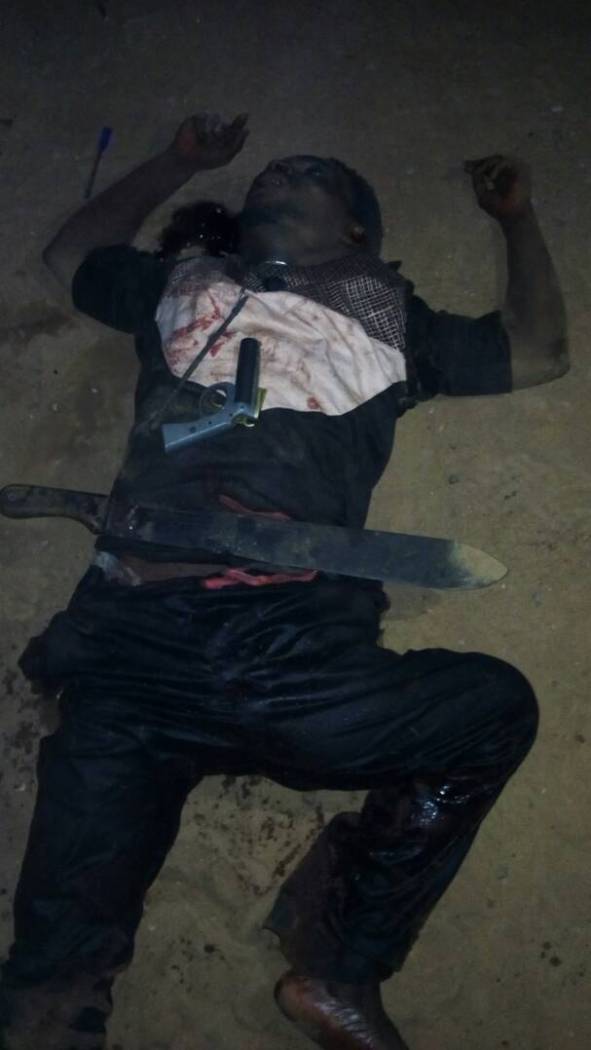
The police in Ogun have shot dead a suspected member of an armed robbery gang that shot and injured a former Divisional Police Officer at Ogbere, Mr Adeyinka Akingbade.

According to Ogun State police spokesman, ASP Abimbola Oyeyemi, the unidentified bandit was shot dead during an encounter with policemen at Ijebu Ife on Christmas Day.

End of the Road: The slain suspect in a picture from the police.

A statement received from Oyeyemi, by NewsmakersNG, says: “The suspect who escaped arrest and fled to Delta State, after shooting the DPO, has been on the wanted list and the command has been on his trail since then.

“Luck, however, ran against him on Christmas Day when police operatives received information that he was sighted in a beer parlour at Itawade area of Ijebu Ife.

Upon the information, the policemen swiftly moved to the place; but before getting there, he had left the place.

He was however traced to his in-law’s house where the police operatives caught up with him.

Having realized that the game was up, he brought out a pistol and started firing at the policemen.

The operatives were left with no other alternative than to fire back consequence upon which he was shot dead.

“Recovered from him are a locally made pistol, a machete, assorted charms and a Toyota Highlander with two different registration numbers.

“It will be recalled that the former DPO Ogbere was shot and seriously injured by the gang during one of their robbery operations at Itele-Ijebu, where the DPO has gone to engage them in gun battle.

The injured officer is still recuperating in the hospital till date.

Meanwhile, the Commissioner of Police (CP) Ahmed Iliyasu has commended the resilience of his men in making sure that the last member of the gang was finally brought down.

He said that the killing was a warning signal to any would be criminal that no crime committed in Ogun State would go undetected.

Story and picture from Newsmaker online


MINING SITE: Sanusi II Wades Into Dangote, BUA Crisis

MINING SITE: Sanusi II Wades Into Dangote, BUA Crisis

The Emir of Kano, Muhammadu Sanusi II, has intervened in the raging controversy between Dangote Group and BUA Group over a mining site located in Okpella area of Edo State.

Africa’s richest man and chairman of Dangote Group, Aliko Dangote, owns Dangote industries limited, the producer of Dangote Cement, while business mogul, Abdulsamad Rabiu owns the BUA Group, producer of BUA cement. Both are natives of Kano.

The conflict over the rightful ownership of Mining Lease No 2541 between the duo has been on in the past few weeks, with both sides engaging in accusations and counter accusations, including name dropping in the media.

Obviously disturbed by the pace at which the war is taking, Emir Sanusi II stepped in by calling the two multi-billionaires to order so as to end the war, which is said to be doing more damage to their relationships and even affecting their business associates.

LEADERSHIP gathered that Emir Sanusi II, who by virtue of his position as the traditional ruler of Kano and father to all, opted to intervened on the matter with a view to finding a lasting solution to the scuffle.

A competent source told our correspondent that the royal father asked the two industry magnates to bury their hatchet and desist from further engaging in media war.

According to the source who did not want to be named in print, the Emir told the businessmen that the raging controversy was counterproductive.

It was gathered that the Emir who is out of the country at the moment, assured that once he returns from his foreign trip, he would call the two sons of Kano to a round table.

“The Emir was disturbed over the matter and has asked them to put an end to the media war. In fact, he has sent emissaries to both men and will interface with them as soon as he returns”, the source said.

Our source further noted that the Emir and by implication, the Kano Emirate council, is worried that the two multi-billionaires are engaged in needless scuffle, which could have been handled in a subtle manner without recourse to rancour.

In the last one-month, the two cement giants had been embroiled in a war of some sort over the ownership of a mining site, which is already a subject of litigation.

The rift took a deeper crisis dimension recently when it escalated with new allegations and counter-allegations by the two companies. Both companies have been accusing each other of using force among other illegal activities.

Several interventions by the Ministry of Mines and Steel Development, the Edo government and other stakeholders have proved futile.

The two companies got their licences from third parties; while BUA obtained its licence from the old Bendel Cement Company through its privatisation, Dangote Group obtained its licence from a company called AICO (Ado Ibrahim & Co) Limited.

The disputed area is at the boundary between Kogi and Edo States, but officials have said that mineral titles are not by state boundary but by the geographic coordinates, which means they can fall in any state.

The Mining Cadastre Office, however, is insisting that BUA overlapped the AICO’s title and that it has no case.

Meanwhile, the case has brought to the fore the weak administration of data of mineral sites in the country, as the titles claimed by both parties are from the same ministry of Mines and Steel Development.

While the BUA group presents mining rights in ML 18912 and ML 18913 in Obu, Okpella in Edo State, Dangote claims right in ML 2541 located in Okene, Kogi State.

Both parties presented evidences that the area where the mining is taking place belong to them and was duly signed by the mining authorities, the ministry of Mines and Steel Development and the Mining Cadastre Office.

The disagreement between the companies compelled the Federal Ministry of Mines and Mineral Development to issue a directive that the Obuh mine, located in Okpella, Edo State should be shut down.

Edo State Governor, Godwin Obaseki, disclosed this while meeting with members of the Okpella community at the Government House.

“There are multiple claims and they have all gone to court. We have a letter from the Federal Ministry of Mines and Minerals Development instructing that the party currently mining that particular site should vacate it, pending the outcome of the decision in court”, Obaseki said.

Prior to this action, BUA Group had accused Dangote Industries of using armed personnel to take over the site and mining illegally.

The company also accused the Ministry of Mines and Steel of frustrating its operations, saying it had written to the Presidency, seeking its intervention.

Dangote Industries, in its defense had claimed BUA Group was illegally mining on a site it had made all the required payments for.

Group executive director of Dangote Industries, Edwin Devakumar, at a press conference in Lagos, stated that the conglomerate had acquired Mining Lease No. 2541 from AICO Ado Ibrahim & Company Limited sometime in 2014.

BUA Group started business in 1988 as a Private Limited Liability Company specializing in the importation and marketing of iron and steel, agricultural and industrial chemicals. Since then it has rapidly developed into a fully-fledged, diversified business with a stake in a wide range of business sectors.

The Dangote group was established in May 1981 as a trading business with an initial focus on cement, but has since diversified over time into various sectors of the economy, including port operations, road construction, salt refining and sugar refining. The group is one of the largest conglomerates in West Africa.